
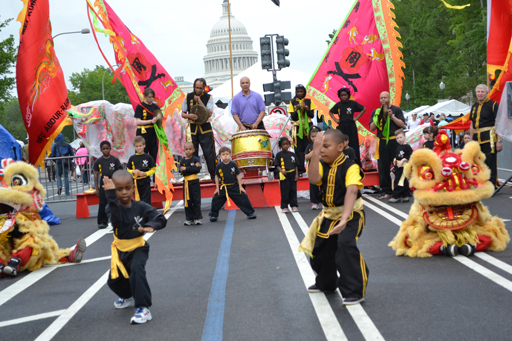
The traditional Chinese martial art known as Jow Ga, Chow Gar or Zhou Jia, founded by Grandmaster Jow Lung, is an effective form of self-defense. This unique style of fighting incorporates the muscular and mighty movements of Hung Gar Kung Fu and the swift footwork of Choy Gar to develop a fighting system which emphasizes simultaneous attacks and defenses. Because of its unique mixture of styles, Jow Ga is often labeled as having the head of Hung, the tail of Choy, and the patterns of the tiger and leopard, or simply Hung Tao-Choy Mei.
The origin of the Jow Ga system began with Grandmaster Jow Lung, born in 1890 in the Sa-Fu Village of Guangdong Province, China. Jow Lung was the fifth elder son of a family of ten children. Jow Lung's interest was also shared by his four younger brothers, Jow Hip, Jow Biu, Jow Hoy, and Jow Tin. The brothers began their martial arts tutelage under their uncle, Jow Hung who taught the boys the Hung Gar fighting system. Jow Lung's dedication to his studies in the martial arts made him the best amongst the brothers as well as winning his uncle's admiration. With his uncle's help, Jow Lung was introduced to a new master, Master Choy Kau (a disciple of the founder of Choy Gar Kung Fu). From master Choy Kau, Jow Lung learned the fast footwork and handwork of Choy Gar Kung Fu. Having the basics taught to him by his uncle, Jow Lung mastered Choy Gar in only a few years.
However, because of family hardship, Jow Lung left home in 1910 for Kuala Lumpur, Malaysia to seek employment. In Malaysia, Jow Lung ran into trouble with local gangsters and found himself seeking refuge in a Buddhist Temple in Penang, Malaysia named Kek Lok Si. One of the monks at the temple, Chian Yi, was most sympathetic to Jow Lung's ordeal. Not only had the monk given Jow Lung refuge, but, after recognizing Jow Lung's strong character, he shared his knowledge of Northern Shaolin Kung Fu (which specializes in kicking, jumping, and leg movements) as well. Chian Yi also advised Jow Lung to blend the three styles he learned to create a style specifically suited for himself (this blending of styles would occur later in his life). Jow Lung remained at the Kek Lok Si temple for over three years before he was ready to return home.
In 1915, Jow Lung returned to Guangdong, to compete for the position of Chief Trainer of the army of warlord general Lee Fook Lam. In a tournament to determine who had the most superior techniques in kung fu, Jow Lung competed against one hundred other participants and came out victorious. He had to win 28 individual matches before making it to the final elimination match where he defeated a well-known fighter named Koon Kam Chi and was then declared the champion. With his newly appointed position, Jow Lung sent for his brothers to assist him in training the soldiers, and most importantly, to create a new form of martial art. Since the surname of the five brothers is Jow, the brothers decided to name their new style of fighting as Jow Ga (Jow family style). Not forgetting the kindness and helpfulness of his past master, Jow Lung often referred to his new style as Hung Tao-Choy Mei (Hung head and Choy tail). In 1917, the brothers opened their first school in their hometown. With countless efforts and united spirits, Jow Ga grew in popularity and the brothers were given the honorable title of "Five Tigers of Jow Ga".
Suddenly, tragedy struck the brothers in 1919. During the influenza pandemic, Jow Lung contracted pneumonia and his health deteriorated rapidly, despite his excellent fitness. Jow Lung passed away at the young age of 29 in 1919. With Jow Lung's death, Jow Biu was chosen as successor and quickly rose to the challenges of his new role. Jow Biu resigned from his post in the army and began promoting Jow Ga Kung Fu. Within a year, Jow Biu set up fourteen (14) Jow Ga Kung Fu schools around China (soon to grow to over 80 schools). Opportunity to spread to Hong Kong came in 1936 when Jow Biu was invited to participate in a Martial Arts Festival for the celebration of the Coronation of King George VI of England. The demonstration was a great success, and Jow Biu was able to establish a Jow Ga branch in Kowloon, Hong Kong. Besides teaching at the school, Jow Biu was invited by the Garment, a Medical Merchant Association, and the Fishery Port Association to be their chief instructor. On March 14, 1961, Jow Biu passed away and the greatness of Jow Ga passed on to all his students. Even now, Jow Ga prevails today and exists in China, Hong Kong, Southeast Asia, United States of America, Canada, Australia, England and Germany and other parts of Western Europe.
Your donation is an investment in our community and directly benefits the free children's programs we provide to DC kids. Together, we can expand our reach and empower more young leaders.